Irreverence
Religious imagery appears frequently throughout Julie Anne Denton's work. Rather than illustrating doctrine or retelling familiar stories, she uses established symbols and belief systems as a means of exploring the contradictions, complexities and unanswered questions that accompany the human experience.
Through symbolism, historical reference and personal observation, Denton's work examines ideas surrounding faith, power, morality, redemption and institutional authority. Whilst many of these works draw upon Christianity, this reflects familiarity rather than allegiance or opposition. The visual language of religion simply provides a rich and recognisable framework through which broader questions can be asked.
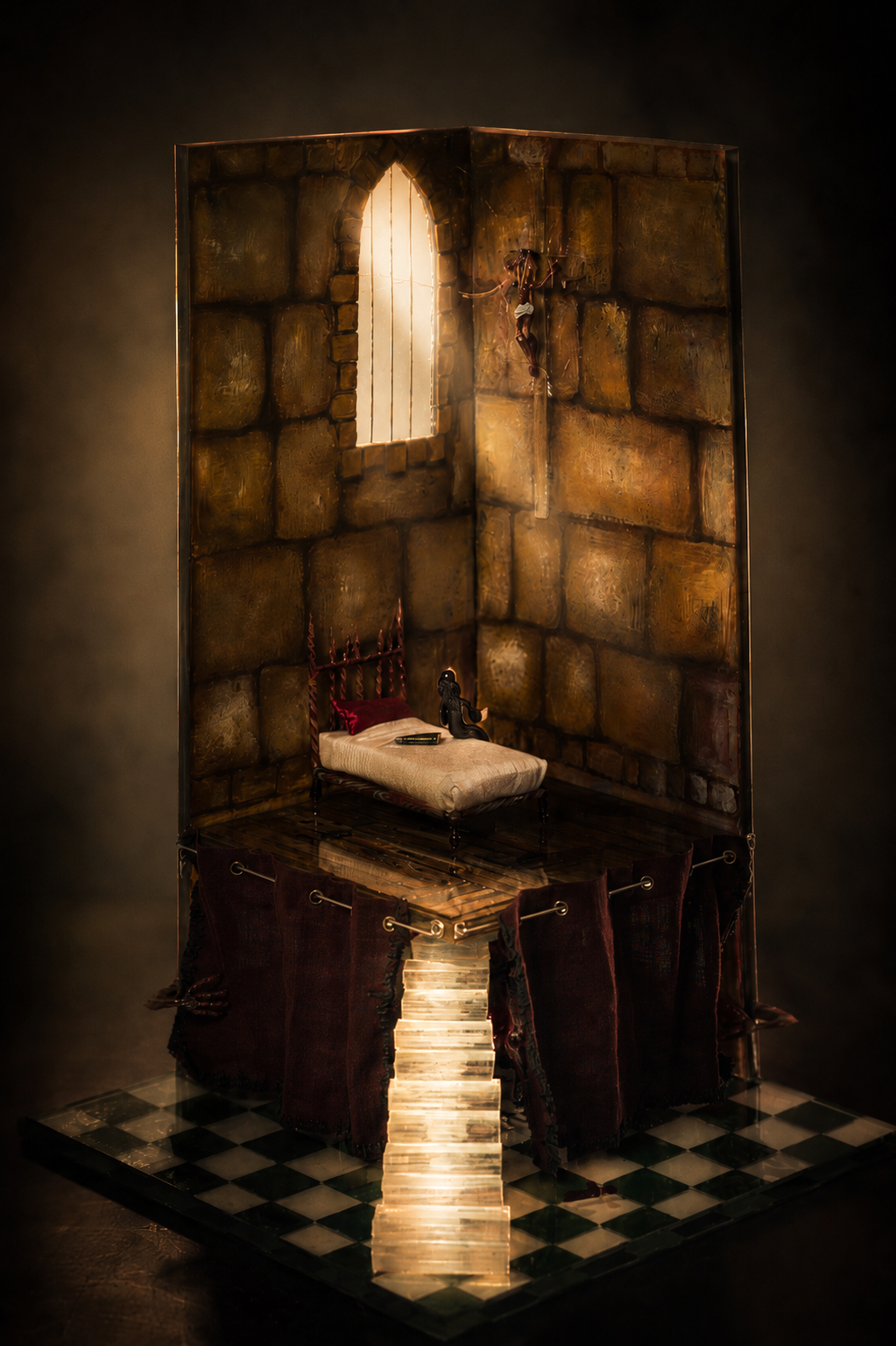
Maria Monk 1836 AD (Anno Dominate)
Maria Monk 1836 AD (Anno Dominate) takes its title from The Awful Disclosures of Maria Monk, a controversial nineteenth-century account describing alleged abuse and corruption within a convent. Whether the book was fact, fiction, or a complex mixture of both remains debated. What interested Denton was not its historical accuracy, but the questions it raises regarding secrecy, power, belief and institutional protection.
The work presents an apparently devotional architectural space: a room, a bed, a staircase and a window. Beneath this surface lies a concealed chamber populated by fragmented figures, relics, newspaper clippings, chains, texts and symbols. Much of the work remains hidden from immediate view, requiring the viewer to physically investigate the piece in order to uncover its secondary narrative.
-
Artist’s secret thoughts
This structure of concealment is central to the work. The visible room represents the public face of institutions and belief systems; the hidden chamber below speaks of those truths, histories and experiences that remain obscured, denied or suppressed. The work is intentionally constructed around the act of looking, inviting the viewer to occupy the uncomfortable position of witness, voyeur and investigator simultaneously.
A laser-etched Sheela na Gig appears within the concealed space. Found on medieval churches throughout Ireland and Britain, Sheela figures are widely believed to represent a much older pre-Christian symbolic tradition that was absorbed into Christian visual culture during the conversion of Pagan communities. Their presence within ecclesiastical architecture reveals the extent to which belief systems borrow, adapt and repurpose existing symbols. Many Sheela figures were later removed, damaged or concealed when changing religious attitudes rendered them uncomfortable or inconvenient. Their inclusion in Maria Monk serves as a reminder that institutions often rewrite their own histories, preserving some narratives whilst suppressing others.
Despite its critical position, Maria Monk is not an attack on faith itself. Hidden on the underside of the work is a quotation from William Blake, whose writings frequently challenged religious authority whilst defending spiritual imagination. The quotation acts as a key to the work's deeper position. The piece questions hypocrisy, concealment and abuse of power, yet remains interested in forgiveness, redemption and the complex humanity that exists within flawed institutions.
Ultimately, Maria Monk 1836 AD is less concerned with religion than with the universal tendency of systems—religious, political, familial or social—to conceal uncomfortable truths behind carefully maintained façades.
“I create because curiosity has always seemed more useful than certainty.”
Julie Anne Denton
Chiliasm – Hail_Pseudapostle_Repetition
Julie Anne Denton’s triptych is an ironic interpretation of the Chiliasm ideology. Chiliasm meaning thousand in Ancient Greek, predicts that Christ will return establishing a Messianic Age of peace lasting a Millenium, prior to the Last Judgement and the future state of “eternity.”
-
Artist’s secret thoughts
Chiliasm – ‘Hail’ ‘Pseudapostle ‘Repetition’
The colour scheme for this triptych is based on traffic light signals: go, slow, stop!
These glassworks were cast in the Isle of Wight with the expert help of glass artist Carl Nordbruch. The glass has a highly transparent gleam because the glass used is lead based, this beautiful glass cannot be obtained in the UK anymore because of the toxicity of lead as it is being mixed. Once the mix (batch) is cooled the lead is non-toxic and highly transparent – hence the term ‘lead crystal’. The metal stands were designed by Dr. Julie Anne Denton and forged by Laxey Blacksmith.
Contraceptive misconception
At the time this work was made, the new pope decreed that using contraception was a sin and Contraceptive Misconception was inspired by this.
-
Artist’s secret thoughts
At the time there was so much poverty in Africa and I simply couldn’t understand why it was still a sin to use contraception when then was so much poverty in these mainly Christian third world countries. The wood the sandcasts are mounted on have a design burnt into them with an Africaneseque design feel. The base of the work is covered in pot potpourri, which is a play on words of Popery which is a pejorative word referring to the doctrines, practices, and ceremonies associated with the Pope or the papal system. In front of the mounted sandcasts is a child’s table and chair. The table is set with knife and fork with an empty plate. Attached to the plate a picture I created by combining a famous picture of a child victim of famine by war photographer Don McCullin with a projected slide of my own dried blood – Black and white with red printed image from film.
The Expulsion
The Expulsion is a piece inspired by the Genesis story of Adam and Eve and their fall from grace. Eve is depicted as a vivacious figure full of curiosity and lust for life, whereas Adam who is symbolically reaching for the hermaphroditic lotus flower with his back to all that goes on, is portrayed as accepting and essentially dull
– A non-player.
-
Artist’s secret thoughts
The encapsulated copper circles are based on the hermetic symbol for spirit, representing God. It is my belief that there are as many gods as there are people to believe in them, and this is why the bottom of the sandcast is peppered with copper figures. There is a ‘T’ shape in the front of the sandcast which has been polished to form a window into the diorama. This is also a reference to God; this shape is inspired by masks – a simplification of the face. A mask is a way of seeing, but not being seen. God (or the viewer) can spy on the events without interfering.
Dimensions and technique
Maria Monk 1836 AD (Anno Dominate)
10mm polished plate glass with high fire enamel, flameworked glass, photographically laser etched glass, cold bonding and mixed media
750 mm x 300 mm x 300 mm
Chiliasm - Hail_Pseudapostle_Repetition
Sandcast lead glass with copper and flameworked inclusions painted in high-fire enamels. Mounted on handmade hanging steel frames
800 mm x 500 mm x 120 mm per piece
Contraceptive Misconception
Installation with mixed media, made from sandcast lead glass with copper and flameworked inclusions painted in high-fire enamels. Fused window glass with high fire enamels, razor blades and fine silver leaf. Found-object table and chair.
1000 mm x 1000 mm x 1800 mm
The Expulsion
Highly polished sandcast lead glass with copper, flameworked and hot-sculpted inclusions painted with high-fire enamels and mounted on coated steel frame
550 mm x 550 mm x 300mm